
At Edgescale, we’re engineering the infrastructure that brings artificial intelligence into the real world. Our work powers AI in the places that keep society running — manufacturing floors, hospitals, utilities, transportation networks, and more. By bridging the gap between the cloud and the physical edge, we enable real-time intelligence where humans and machines work together.
Part 1 of a series on sovereign AI and the role of Physical AI Infrastructure in enabling sovereignty.
Infrastructure is the advantage
Edgescale was founded on the principle that infrastructure – energy, communications, computing – is a competitive advantage (Extending the Cloud to Scale AI in the Real World, 2024). For nations, software companies, and enterprises alike, it can differentiate or limit the ability to operate, and in some cases destroy it.
This principle has never been more true than for AI and the infrastructure to support it. AI is transforming our technology, the way we work, and our collective knowledge: unlocking superhuman abilities for decision-making, the ability to operate complex physical systems with AI, and the extraction and organization of vast domain knowledge, as just a few examples.
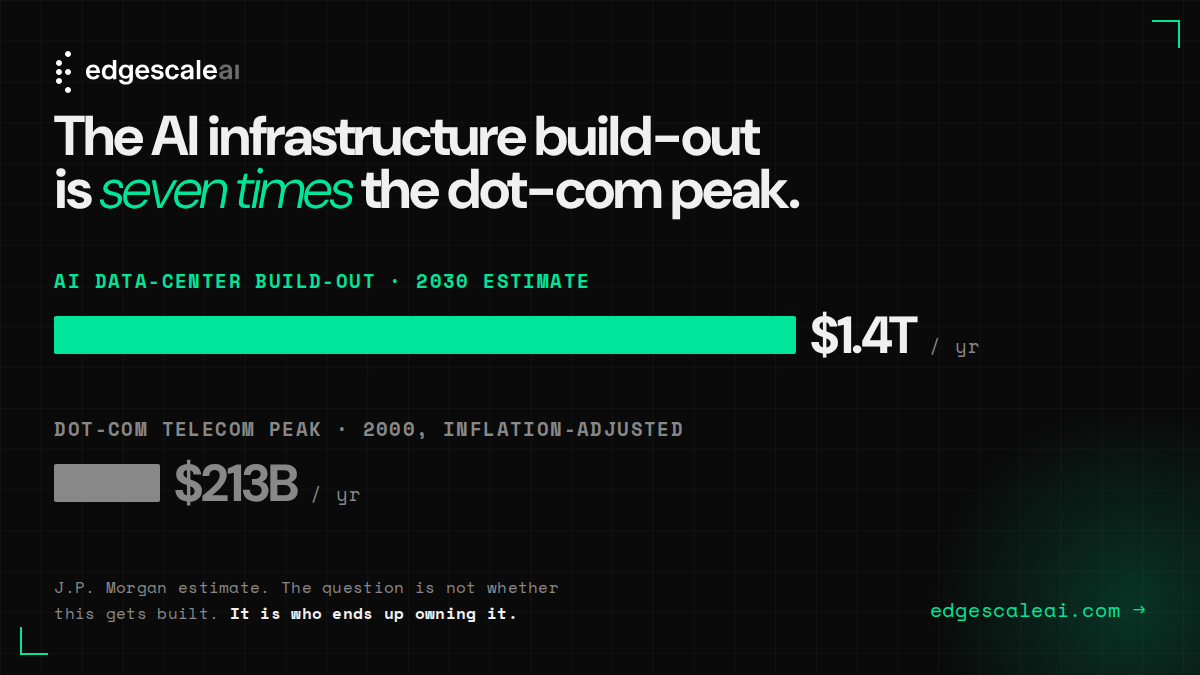
The profound nature of AI and its massive demand are now rewiring our infrastructure. J.P. Morgan estimates that AI data-center build-out will reach $1.4 trillion a year by 2030. In contrast, the inflation-adjusted peak of the dot-com telecom buildout was about $213 billion in 2000 – roughly a seventh of that. This tectonic shift raises the question: how will this infrastructure be built? What competitive advantages does it bring, what options does it foreclose, and for whom?
At the same time that we seek to harness AI, we must consider our structural ability to access, control, and benefit from it – in other words, the full-stack sovereignty of our AI.
Where we stand
Palantir is right (Protect Your Sovereignty). As highlighted in several recent thought-leadership pieces, and in Alex Karp’s latest CNBC interview, AI sovereignty is already eroding – enterprises and nations are at risk of losing their alpha (their unique competitive advantage & proprietary edge), while the infrastructure they depend on systematically undermines their ability to compete any other way. As Karp put it, what enterprise customers want is “control over their compute, their models, their data stack, and their alpha.”
Businesses now rely on AI to function and the dependence is growing: customer delivery and product, back-office operations, and increasingly mission-critical and safety-critical operational systems. As businesses transfer share-of-work to AI and the businesses become unable to function or compete without it, it is not optional to consider the existential implications of this dependency. More positively, we see the inverse to be true as well. Companies that embrace AI gain enormous productivity and agility – those that make this a durable advantage will outcompete the market.
For this reason, we believe that enterprises should own their own AI. In the most likely case, converging to hybrid enterprise-owned and -operated infrastructure with a sovereign runtime for AI, tighter control of essential data, and sovereign models that encode the knowledge of the enterprise in weights.
This post, and the subsequent series, expand on these points and share how we arrived at this conclusion.
While easier said than done, it’s a vision we’ve pursued since founding the company. We’re proud to have partnered with Palantir since 2023 to deploy sovereign models and applications on premise, and we have since extended our partnerships with NVIDIA, Red Hat, Hitachi, and other leaders in this space. Our product takes an uncompromising stance on ownership: it keeps custody of data and models in the hands of our customers.
In 2026, we signed the Open Weights and American AI Leadership statement, in support of a thriving ecosystem of choice and control that provides the optionality and leverage enterprises need. We’ve seen in our own Sovereign AI stack (more in a future post) the impact of model options and open weights enabling rapid set-up and iteration of capabilities — generating billions of tokens for us, a guaranteed ability to produce, and ultimately a competitive advantage. And we’re making it possible for businesses to own their AI too.
The necessary conditions for sovereignty
So what exactly is sovereignty? Ultimately, control. [I know… insert The Matrix joke here.] Do you maintain control of your business and its ability to compete, or do you cede that control to someone or something else, like a supplier or a model? It’s not always easy to tell.
Note that we’re not limiting this to control of the AI. One follows the other, but unlike commonplace business technologies, the stakes are higher with AI. If I lose control of my video conferencing, point-of-sale systems, or inventory management system, my business is in peril. If someone takes control of my AI and withholds it from me, or gives it to a competitor, my business doesn’t exist.
The more that AI takes on the work of our businesses, the more that sovereignty of AI is sovereignty of our business. We must therefore consider AI closer to how we consider cash, data, and human capital – which are part of our business strategy and alpha, and part of our business continuity and disaster recovery plan, at the very least.
In practice, we hold that AI sovereignty comes down to two conditions: a guaranteed ability to produce, and authority over your own information.
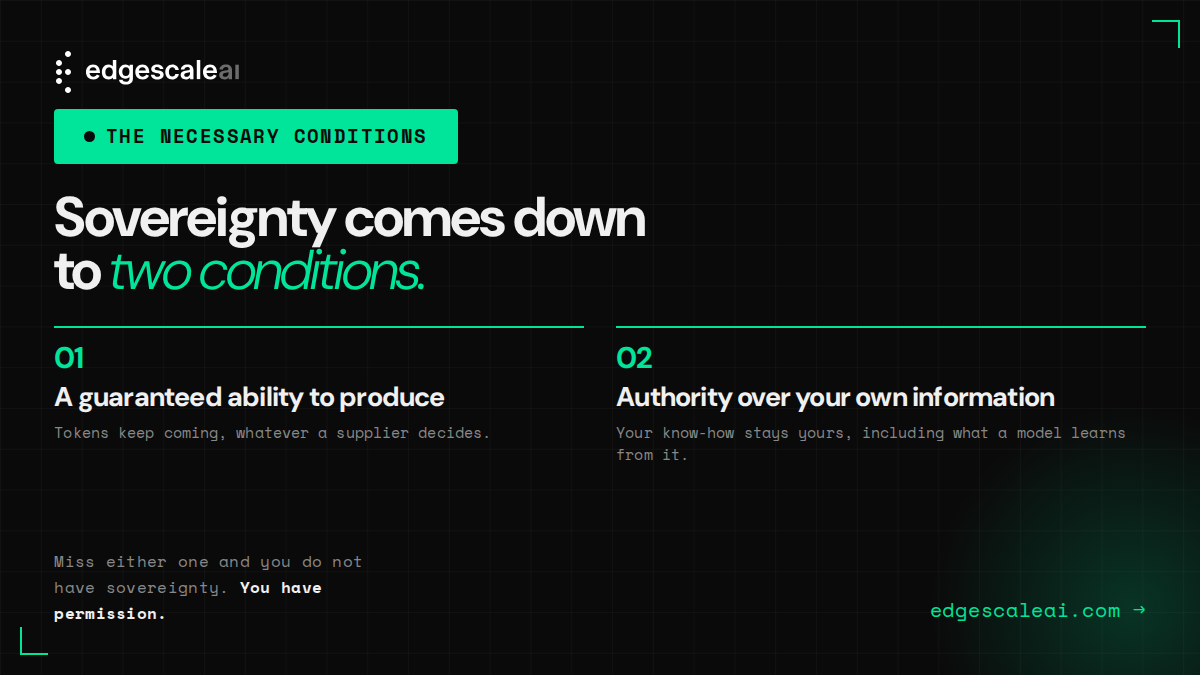
Condition one — A guaranteed ability to produce
Electricity is important for most businesses. We’re fortunate, in developed and conflict-free countries, that energy is generally available and reliable. It is also government-regulated to be stable and non-discriminatory between businesses. Yet, many businesses employ backup power generators and alternative sources of power – in manufacturing, airports, data centers, office complexes – because they simply can’t afford the impact to their business of an inability to produce electrons.
AI is becoming similarly vital, load-bearing infrastructure with none of the guarantees and safeguards. GPU and memory scarcity and preferential access are commonplace. As demonstrated recently, providers may decide or be compelled by a third-party to withhold access. Model deprecations, price changes, rate limits, outages, or a provider simply deciding your use case is no longer welcome (due to some policy) all sit outside your control and are points of failure you do not control.
Sovereignty means you either have the ability to produce or you don’t. Just as we assess for electricity, what is the impact to your operations of the interruption or loss of token generation? What does it mean if you’re able to grow unconstrained and operate independently? And how does alternate supply produce leverage? These are all fair and important questions – which we’ll dig into later – when it comes to AI and the ability to produce.
Condition two — Authority over your own information
The second and more talked-about condition is authority of information – how your IP, know-how, and trade secrets are handled. The question is not ownership of the information. It’s about the transfer of rights over how it can be used, leveraged, accidentally leaked, and derivative ownership. It is about the dire repercussions of losing control of your information.
Others have already cited the issues, acute to an AI system: the difficulty of even knowing what information leaves, the difficulty of knowing how it is actually used once it leaves your possession, the classification of derivative works from “feedback,” and the possibility of the rules changing after the fact. They say possession is 9/10th of the law. Once someone holds all of your data, you have far less leverage and fewer options – only the authority they give you.
Loss of control may not pose a problem for certain data categories: customer analytics, purchase orders, marketing signals, and software logs (four of the biggest SaaS categories) for example. However, mission-critical data (e.g., the industrial process controls of a metal smelting business) are existential. The smelting process – the recipe – is the essence of this company, built up over decades. If a model were to learn how this company and its employees smelt metal in exquisite detail, even better than recorded in company documentation, then anyone could do it. It loses its alpha, and the business struggles to exist.
The upside of AI for businesses is knowledge management. When implemented well, AI is powerful, easy, and addicting. Why wouldn’t you want to use something that makes you a more capable, faster, and efficient version of yourself? This makes AI itself a fantastic source of human information such as intention, experience, and knowledge not easily captured in records or databases, which could make it a more durable and profitable business, and which silently passes to whoever controls the AI. The upside is undoubtedly greater: who controls and keeps this upside is what’s at stake.
Sovereignty means you retain the authority over work performed with your information and no one can take it away. The problem of AI Sovereignty is not outsourced storage and processing of data. It’s that the nature of data in an AI system is both more valuable, less clear, actively encoded into derivative models and transformed into work – if you no longer control the work that your business does, do you still control your business?
What’s at risk
Someone has sovereignty over your AI. We think it should be you.
The advantages and risks are extreme, higher than any other technology enterprises use, which is why we see this topic as being past the inflection point into a non-optional, existential category. As we lean more on AI to do work, the need to guarantee supply drives businesses to own and operate their own capacity — at least partially, in hybrid and backup capacities. At the same time, enterprises cannot miss the opportunity to capture their own knowledge — which results in enriched data and proprietary owned models that, to a very real degree, are their business. That’s why we are so confident in the statement made earlier in this post that AI must converge toward sovereign infrastructure.
It is not, however, a foregone conclusion how successful each enterprise will be, and how concentrated or ubiquitous AI sovereignty becomes. AI and supporting infrastructure is already sovereign for hyperscalers, neoclouds, AI model providers, and large tech companies. They are investing hundreds of billions every year because they understand this reality: you either secure control over your AI infrastructure or you’re left behind at the whims of someone who did.
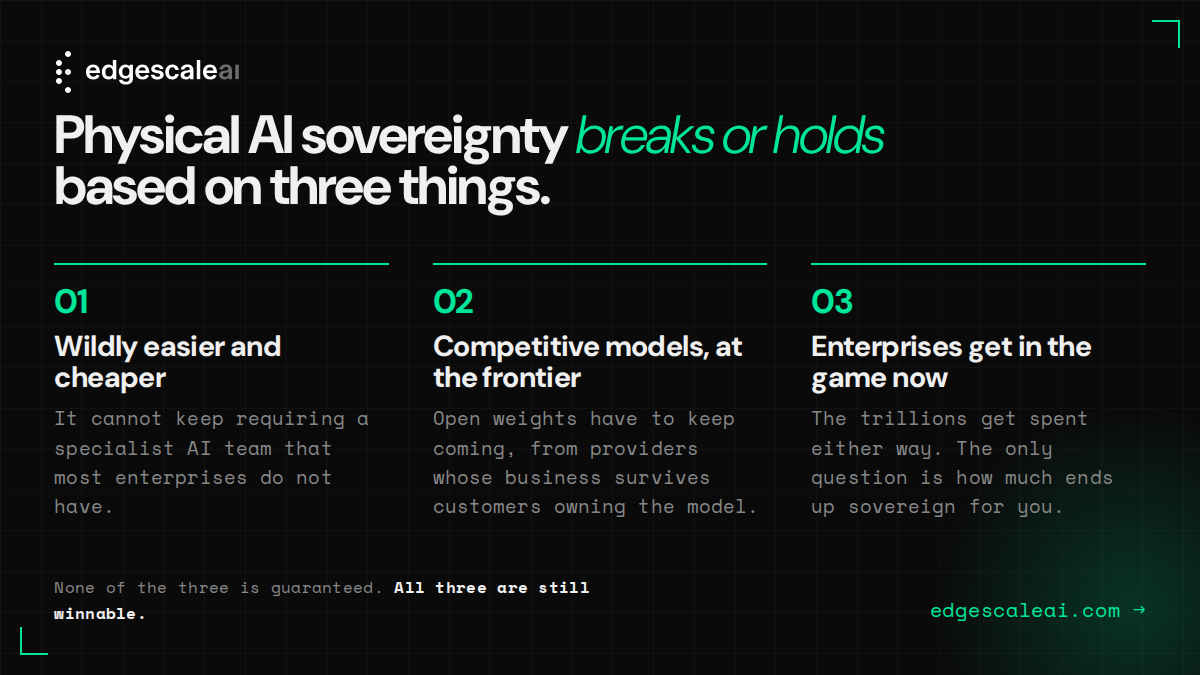
Whether this is generally true or whether enterprise sovereignty breaks, depends on the following:
- It must be wildly easier and cheaper to implement. Without small, portable generators or solar paneling, few could afford their own supply of electricity. So long as setting up and continuously improving sovereign AI requires specialized AI teams, beyond the current expertise level of enterprise technologists, few can keep up.
- We need a continuous supply of competitive models and model providers that support enterprise sovereignty, at or near the frontier. Anyone who has tried to use a two-year-old model knows it won’t be tenable for enterprises to maintain sovereignty at the cost of intelligence and frustration. Sovereign AI must be competitive and enable enterprises to achieve productivity and experience gains.
- Enterprises need to invest now. On a pure infrastructure basis, trillions of dollars will be spent on power, chips, and software to produce enough tokens for global demand, either way. Enterprises have to get in the game now to ensure at least some of that infrastructure is sovereign for them. Once the infrastructure of the AI era is laid, availability, performance, and cost become insurmountable barriers for your own AI to compete with a provider’s — the infrastructure advantage having been ceded without realizing it, and the race lost before it began.
The incumbent infrastructure and model providers would have you believe that sovereignty is already broken, that it’s too late, or that it’s actually not a problem (because to them, it isn’t). They are ahead.
Leaders in our ecosystem – Palantir, NVIDIA, Red Hat, and us – say differently. We are committed to giving enterprises the choice. The choice to have their own production by making it easy and cost-effective to deploy and use AI infrastructure – what we call “AI reactors.” To maintain authority over their own information, models, and output by embracing open-weight models and model providers with sovereign-compatible business models. The tectonic plates of AI and infrastructure are moving and unstoppable. The time to consider your sovereignty, for the coming decades, is now.