
At Edgescale, we’re engineering the infrastructure that brings artificial intelligence into the real world. Our work powers AI in the places that keep society running — manufacturing floors, hospitals, utilities, transportation networks, and more. By bridging the gap between the cloud and the physical edge, we enable real-time intelligence where humans and machines work together.
American manufacturing’s biggest productivity gains aren’t waiting on new plants. They’re trapped in existing data and equipment on the floor that AI hasn’t been able to reach.
Walk the floor of a plant that’s hitting its numbers and you’ll see a strange thing in its own data. The lines run, the product ships, the quarter closes on target – yet the telemetry coming off those same lines says the operation is leaving double-digit output on the table every shift. Not because anything is broken, but because the real-time intelligence needed to act and optimize isn’t able to access the physical operations. 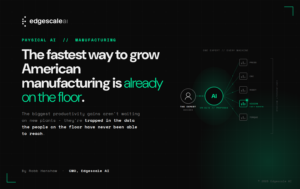
When a manufacturer wants more out of an operation, the instinct is to add another line, shift, or site. That work has its place, and sometimes it’s the right call. But it is rarely the fastest way to expand what a plant can actually produce, and it’s almost never the most cost-effective. The fastest way is to get more out of what’s already running – the equipment already installed, and the people already on the floor.
That’s the productivity hiding in plain sight across American manufacturing. Today’s plants are often running well below what they’re capable of, because the intelligence needed to optimize production has never been able to reach the place where the physical work happens.
The problem isn’t the machines. It’s the knowledge walking out the door.
On most factory floors throughout the country, you’ll find maintenance leads who can walk past a press and know, from the sound alone, that a bearing has maybe a week left. You’ll see a line operator who feels a process starting to drift before any gauge flags it. The people running these operations are extraordinary at their jobs, and most of what keeps a plant running lives in their heads, not in a manual.
But that’s part of the problem. The average U.S. factory has been in operation for decades, and the systems inside it were built for an era when the expert was always within earshot of the machine. The controller on a line was spec’d in the 1980s. The monitoring software is probably running on a version of Windows that’s a decade old. None of it was ever designed to capture what the veteran operatpor knows, let alone share it. So when that veteran retires – and across manufacturing they are retiring faster than anyone can train replacements – the knowledge leaves with them. The bearing nobody else can hear. The drift nobody else can feel. Decades of pattern recognition, gone at the end of a shift.
The cost of that gap is significant. Asset-heavy operators routinely lose 5 to 20 percent of revenue to unplanned downtime, and very little of it traces to worn-out equipment. It traces to warning signs that were sitting right there in the data, in places where nothing could read them, until the failure that one retiring expert would have caught becomes a line-down event that nobody did. The equipment isn’t the constraint. The ability to see what the equipment is telling you, across the whole operation, fast enough to act, is the constraint.
Physical AI as a force-multiplier for your best people
When we talk about Physical AI in a manufacturing setting, the goal isn’t to take the expert out of the loop. It’s to take everything the expert already does well and amplify it.
An experienced operator can watch one line closely. Physical AI lets that same judgment watch twenty, continuously, without fatigue, flagging the anomaly on line 14 while the operator is standing at line 3. The maintenance lead who can hear one failing bearing can now have every rotating asset in the plant listened to the same way, all the time, with the early warning routed straight to them. The work doesn’t change. The reach does.
And the knowledge stops walking out the door. When a veteran’s pattern recognition is captured in a system – the specific signature that precedes a specific failure on a specific machine – it doesn’t retire when they do. It becomes something the next operator inherits on their first day instead of earning over fifteen years. The expertise compounds instead of evaporating.
The relationship between AI and the expert operator is deliberate, and it matters: the AI proposes, the operator decides. The system surfaces what it sees – a drift, a deviation, a pattern that matches a failure it has learned – and the person on the floor, with all the context a model doesn’t have, makes the call. The plant’s best people don’t become less relevant as intelligence reaches the floor. They become more capable, covering more ground, catching more problems earlier, and spending their judgment on the decisions that actually need it.
The intelligence has to live on the line, not in a data center
Most of what we call AI today runs on data that has already been collected, cleaned, and parked somewhere in the cloud. Physical AI works differently. It runs on the data being generated right now by the equipment doing the physical work in your factory – the vibration sensor on a press, the camera at an inspection station, the telemetry streaming off a CNC cell, the torque trace on a fastening tool as the bolt turns. It reads that data where it’s born, on the line, and acts on what it sees in near real time, not after the fact from a warehouse a thousand miles away.
When AI can finally see across an operation that way – all of it, continuously, in context – the math of industrial output changes dramatically. Industrial AI deployments in real environments routinely deliver 5 to 20 percent quality and yield gains, 10 to 30 percent productivity improvements for the people running the line, and a 25 to 30 percent reduction in unplanned downtime.
This isn’t a projection – it’s happening on floors today. Condition agents watching thousands of data points off rotating equipment catch the cascade before it starts and open the work order automatically, before a single operator has to notice. Vision systems at inspection stations flag the microscopic defect that a tired eye misses at the end of a long shift, cutting scrap and rework instead of shipping the problem downstream. Throughput climbs on lines that didn’t add a single new machine. None of it required new construction. It required connecting equipment that was already running to intelligence it had never been able to reach.
With Physical AI, we aren’t rebuilding the factory floor – we’re connecting the facilities we already have to the intelligence they have been missing.
An adaptive plant can do things a hardwired one simply can’t
A plant that can finally use its own data isn’t just more productive. It’s structurally different from a hardwired operation, in ways the people running it feel almost immediately.
Start with how fast it can change. When a line is hardwired, changing what you make or how you make it is a project measured in months – reprogramming, requalifying, revalidating. When operations are continuously informed by AI running locally, you can reconfigure a line, reroute a process, or stand up a new capability in days. The modular production cells that drop in next to a plant and build specific components on demand only work because intelligence is doing the orchestration underneath them.
Then there’s what happens when something goes wrong upstream. Hardwired systems are brittle by design; when an input is late or a spec shifts, they stall and wait for a human to intervene. A plant whose systems can sense, decide, and adapt locally absorbs that shock instead of buckling under it – rerouting, rebalancing, and holding output where a rigid line would simply stop.
And there’s the matter of control. Intelligence that runs sovereignly on-premises, on the operator’s own data and inside the operator’s own walls, means a plant owns how it runs rather than renting that capability from a platform in the cloud. The data that describes exactly how you make your product – the most competitively sensitive thing most manufacturers have – never has to leave the building for the intelligence to work.
The floor is the hardest place on earth to run AI
The AI models needed for this to work have existed for years. But factory floors are one of the most demanding compute environments, with requirements that generic cloud infrastructure cannot meet.
A stamping line can’t pause to wait for a cloud round-trip; the decision has to happen at the speed of the machine, and the machine doesn’t slow down when the network does. The data describing how a plant makes its product is competitive intellectual property that often can’t leave the site for legal or contractual reasons, which rules out shipping it to a hyperscaler. And the floor is unforgiving in a way a digital business never is: a model that misses a drifting tolerance or a guarding fault can result in a person going to the hospital, not just scrap a part. Cloud infrastructure built for web applications fails all three of those tests.
Closing that gap is exactly why we built Edgescale, to deliver purpose-built infrastructure for AI that lives where the data lives. There are two key things that set the Edgescale model apart:
It keeps running when the connection drops. With Edgescale, intelligence is served locally, inside the plant’s own security perimeter, and reaches out to external models only when policy allows it. When the link degrades or disappears, the system disconnects cleanly and the line keeps running. Local autonomy is the default. The cloud is an option, not a dependency.
It’s safe by construction, not by configuration. You cannot drop a large language model into the control path of physical equipment and hope it behaves. Industrial environments can’t tolerate non-deterministic behavior on anything safety-critical, so we made it structurally impossible. The AI can propose an action; it can never approve or execute one on its own. Every action clears a deterministic gate against formally verified rules before anything moves. Identity is rooted in hardware, data is encrypted at the source and never leaves the plant network, and there’s no public endpoint to attack in the first place. That last point isn’t hypothetical: in December 2025, a federal advisory documented active attacks doing physical damage to U.S. water, food, and energy systems through exactly the kind of exposed interfaces this design removes.
The gains are already on the floor, waiting for the means
More lines and more capacity have their place, and that work is important. But it runs alongside a faster, cheaper source of leverage that’s already sitting in the plant – the equipment already installed, the data already flowing off it, and the people who already know exactly what to do, waiting only for the means to do it across the whole operation instead of one machine at a time.
That’s where the productivity has been hiding all along. Not in a plant we haven’t built yet, but in the one already running, and in the operators already standing on its floor. Put Physical AI in their hands – with the safety and the control these operations demand – and you don’t modernize a handful of plants. You change what the entire industrial base can produce, using the advantages you already have.