
At Edgescale, we’re engineering the infrastructure that brings artificial intelligence into the real world. Our work powers AI in the places that keep society running — manufacturing floors, hospitals, utilities, transportation networks, and more. By bridging the gap between the cloud and the physical edge, we enable real-time intelligence where humans and machines work together.
Washington is moving cautiously, and for understandable reasons.
This week President Trump signed an executive order requesting that AI companies voluntarily give the federal government early access to their most advanced models – up to 30 days before those models reach other trusted partners. The driver is security. The administration is worried about a specific class of frontier models: systems capable of finding and exploiting cybersecurity vulnerabilities at speeds no human defender can match. The order stops short of mandatory pre-release approval, which means it lands somewhere in the middle of a debate that has been running inside the administration for months, between the instinct to minimize regulation and the recognition that some safety risks are real.
The capabilities that prompted the order are not science fiction. When a model can surface thousands of previously unknown software flaws across the systems that run our hospitals, our banks, and our utilities, the government’s interest in getting a look first is not hard to justify.
But here is what concerns me about the way this conversation is framed. While the federal corridors fill up with arguments about how to govern the most powerful models on the internet, a far larger and more immediate opportunity is going almost entirely unaddressed. There is a place to deploy AI where it is simultaneously the safest, the most impactful, and the most immune to the exact risks driving all this regulatory anxiety in the first place.
That place is Operational Technology – OT – the industrial nervous system of American infrastructure.
Most people think of AI as a cloud phenomenon. A subscription service that you access over the internet, running on remote servers, dependent on a connection and subject to every vulnerability that connection introduces.
That model is fine for a chatbot, but doesn’t work when applied to our critical systems.
In an industrial setting, the failure modes that come bundled with cloud AI are not abstractions on a risk register. Hackers, latency, and reliability failures are operational realities, and in the worst cases, they are catastrophic ones. A delayed signal in a power grid, a compromised sensor on a manufacturing line, or a ransomware intrusion into a water treatment facility is not a data breach. It is a public safety emergency that affects the people downstream of that plant. These risks have made OT operators rightfully skeptical of conventional AI adoption.
The people who run these systems understand this better than anyone, which is precisely why so many of them have kept conventional AI at arm’s length. Their caution is not technophobia – it is professional judgment. They have spent careers being accountable for systems where the cost of being wrong is measured in lives, not in dollars. When the dominant model for AI adoption asks them to route their most sensitive operational data out to a cloud server and trust it to come back in time and intact, they are right to say no.
But there is a path that dissolves this dilemma: on-premise Physical AI deployment.
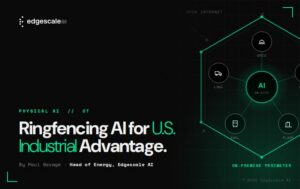
When a model runs locally, processing data from the machines, sensors, and systems already on-site, it never touches the internet. There is no cloud dependency to sever the connection at the wrong moment. There is no latency bottleneck between the decision and the machine acting on it. There is no external attack surface for an adversary to probe, because there is no external connection to probe. The data stays where it was generated, and the intelligence that acts on that data stays where it is needed.
On-premise AI for industrial environments is not a workaround. It is not a watered-down version of the real thing for customers too nervous to go to the cloud. It is the architecturally correct answer for environments where the data is sensitive, the timing is unforgiving, and the connection is a liability rather than an asset. The cloud model is the compromise. Running the intelligence where the work happens – with Physical AI Infrastructure – is what’s required for the safety and sovereignty of our most critical systems.
The sectors that stand to benefit are foundational: manufacturing, electric utilities, transportation networks, aviation, water systems, and critical logistics infrastructure. These industries employ tens of millions of Americans and underpin every other sector of the economy. They are also, by and large, running on aging systems with enormous untapped efficiency potential. On-premise Physical AI can unlock that potential — optimizing energy consumption, predicting equipment failures before they occur, improving worker safety, and strengthening supply chain resilience — without introducing the risks that have kept AI at arm’s length from OT environments.
This is precisely where federal action can make a difference.
The instinct to scrutinize frontier models is sound, and I am not asking anyone to drop it. But if federal energy goes exclusively toward managing what the most powerful AI might do wrong on the open internet, Washington will miss a chance to advance the national interest on ground where it already holds a strong hand.
The government should simultaneously be creating incentives and pathways for AI deployment in ruggedized, on-premise industrial settings. The tools to do this already exist. Procurement frameworks can favor architectures that keep critical infrastructure data on-site. Energy loan programs can underwrite efficiency and resilience projects that bring this capability into utilities and manufacturers. Defense and DHS partnerships can accelerate adoption in exactly the sectors where the government already has deep relationships, deep expertise, and an unambiguous national interest in seeing them modernized and hardened.
The executive order debate is fundamentally about managing what AI could do wrong on the internet. It is necessary work, and it is hard, because every safeguard has to be weighed against the risk of falling behind.
The OT opportunity is about something else entirely. It is about what AI can do right without the internet at all. There is no innovation-versus-safety tradeoff to agonize over, because keeping the intelligence on-premise is what makes it both safer and better at the same time.
While both the executive order concerns and the OT opportunity are worth pursuing, the OT path provides the rare opportunity where the safe choice and the ambitious one are the same.