
At Edgescale, we’re engineering the infrastructure that brings artificial intelligence into the real world. Our work powers AI in the places that keep society running — manufacturing floors, hospitals, utilities, transportation networks, and more. By bridging the gap between the cloud and the physical edge, we enable real-time intelligence where humans and machines work together.
Every model I work with is frozen, and inference does not change it. Whatever it works out on the way to a good answer leaves no trace in the model itself, and the next request starts from the same place the last one did.
That is easy to miss, because AI systems obviously do appear to remember things. The assistant I use daily can pick up a thread from last week. But the model is not what is doing that “remembering.” Something outside the model kept a record and handed it back as input on the next request. Every case of apparent memory in these systems is a store plus a retrieval step, wearing the model as a face.
There is exactly one way to write into a model directly, which is to train it, and it makes a poor memory system for anything operational. It is slow and expensive, you cannot read a specific fact back out, you cannot trace where anything came from, you cannot revise a single entry, and when you are done the result sits inside weights you probably do not own.
So the question we had to answer early on when building our Sovereign AI Factory was not which model to use. It was: If the intelligence is stateless, and the only direct write path into it is somebody else’s training run, where does our accumulated knowledge actually live?
We decided our answer was that we needed to make the store the only thing that is real when it comes to system memory.
The artifact is the medium
Every agent in our Sovereign AI Factory has exactly one input and one output, and both of them are the store. An agent polls for artifacts of a type it cares about, applies its single rule, and writes a new artifact. It cannot call another agent. It cannot hold state between passes. It cannot hand anything to anyone directly. This is enforced in code.
As a result, nothing in the factory exists except as an artifact in the store. The idea, the prototype, the test suite, the execution evidence, the quality score, the security finding, the repair order, the certification – every one of those is a durable object, not a message that passed between two processes and then evaporated.
That is a different thing from having good logging. Logs are a description of work that happened somewhere else, written alongside the real activity, and they are almost always the first thing to get truncated. Here there is no “somewhere else.” If it is not in the store, it did not happen, because the store is the only channel the work can travel through.
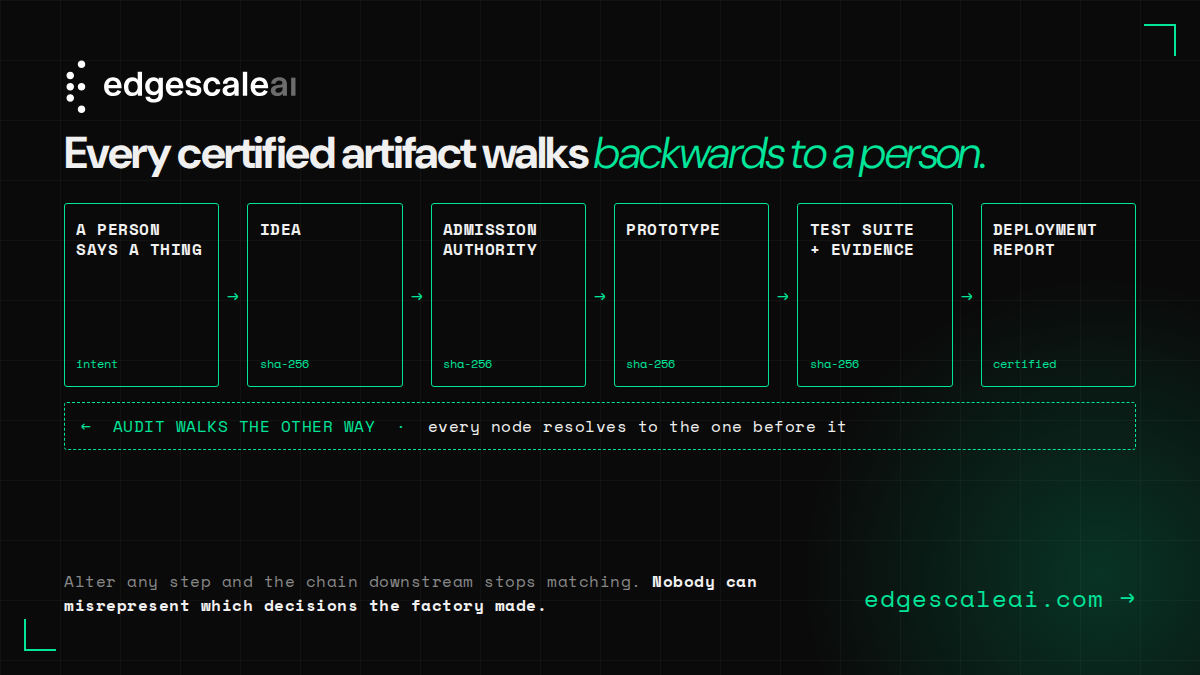
Each artifact is content-addressed with a SHA-256 hash and chained back to the artifact it came from, all the way to the originating idea. So the store is not a pile of files – it is a graph. And every node in it can be traced to the command a person gave at the beginning.
What this enables
Provenance is the kind of thing that sounds like a compliance feature (and often gets budgeted like one). But it’s deeper than that. Every debugging story I told in Part 2 was only possible because of the store.
When the execution pass rate sat under one percent and we suspected the harness rather than the prototypes, we pulled a sample of failures apart by hand and confirmed it. That investigation was possible because the evidence from every one of those runs was still sitting there, in full, weeks later (in the store). If verification output had been a log line, the answer would have been that pass rates were bad and we did not know why.
Then we decided that setting the accept threshold at 8.0 was too strict and dropped it to 7.0, and we re-scored the backlog against the new bar. Nothing got rebuilt. Nothing got re-run. The prototypes and their evidence were already there, so changing the standard was a re-scoring exercise rather than a redo. That was only true because the artifacts outlived the decision that judged them.
And the repair loop works the way it does for the same reason. When a prototype fails, remediation gets the ground-truth record of the failure rather than a summary of it. That is not a design flourish. It is just what is available, because the record is the only thing that was ever produced.
None of those three are compliance. They are the difference between a system you can reason about and a system you have to trust.
The control question
The most common objection I hear about autonomous agents is not about accuracy – it’s about control. Nobody responsible for a factory is going to let a loop like this run unattended unless someone/something can answer “why is this running on my line?”
The hash chain is the structural answer to that. Any certified artifact can be walked backwards: this deployment report came from this evidence, which came from this test suite, which came from this prototype, which was admitted under this authority, which came from this idea, which came from this person saying this particular thing. Because each link is a content hash, you cannot quietly change a step in the middle. Alter anything and the chain downstream stops matching.
Our CTO Marc makes the stronger version of this point, which is that immutable logging back to human content and intent addresses the number one fear people have about handing work to agents. I would put it more narrowly – that the chain does not prove the factory made good decisions. It proves nobody can misrepresent which decisions it made, and those are different claims. The second one is one you can actually build on.
What broke along the way
Three things broke, and none of them was a model producing bad output. All three were the store being incomplete in a way that nothing surfaced – which is the failure mode you have to care about once the record is the only thing that is real.
The suites went stale, and stranded 624 prototypes.
A system we call Black Widow authors the tests, and partway through I changed how it authors them. The older logic produced suites with real defects baked in – curl against something that only speaks HTTP, command-line calls to a service, relative paths into a bundle, expected strings that were guessed rather than grounded. Fixing the authoring did nothing at all for the prototypes that already had a suite. Nothing in the pipeline goes back and looks again. A prototype holding an old suite and no evidence is not failing, and it is not queued – it is simply never picked up. 624 of them were sitting in that state before I understood that was what I was looking at.
The fix is unglamorous. Every suite now carries the version of the logic that wrote it, anything older is discarded, and that prototype is re-authored in place, twenty-five per cycle so it does not turn into one enormous burst of inference. We are on the fourth version of that logic now.
What makes this a story about the store rather than a story about a bug is what the fix was able to do. The 624 prototypes were still there. Their ideas were still there. So the repair reached backwards and picked all of them up where they sat. Nothing was rebuilt and nothing was re-run, for the same reason the threshold change cost nothing: the artifacts outlived the logic that made them.
Nine out of eleven spoken ideas never became prototypes, and the average hid it.
The generation used to be one-shot. If the model returned something unusable, the code logged it and moved on, which left an idea sitting in the store with no Prototype attached to it. Nothing would ever come back for it. The repair loop only repairs a prototype that already exists, so an idea that never produced one is not failing anywhere – it has quietly stopped at the first step.
What is worth sharing is how long that stayed invisible. Across the whole store the numbers looked immaculate: 11,650 ideas, 11,633 of them with prototypes. The bulk of those are imported in pairs, an idea and its prototype arriving together, so that aggregate could not have looked anything but healthy. On the path I actually care about – somebody says a sentence out loud and the factory builds it – the real number was 2 out of 11.
The store was not wrong. Every one of those orphaned ideas was sitting in it, complete and correct and going nowhere. The average was wrong. A record that keeps everything will let you compute a number that describes nothing you care about, and I did that to myself for longer than I would like to admit. There is a sweeper now that retries orphaned ideas, paced so it cannot monopolize the gateway.
An outage got written down as a defect in the work.
This is the one I want other people to avoid most.
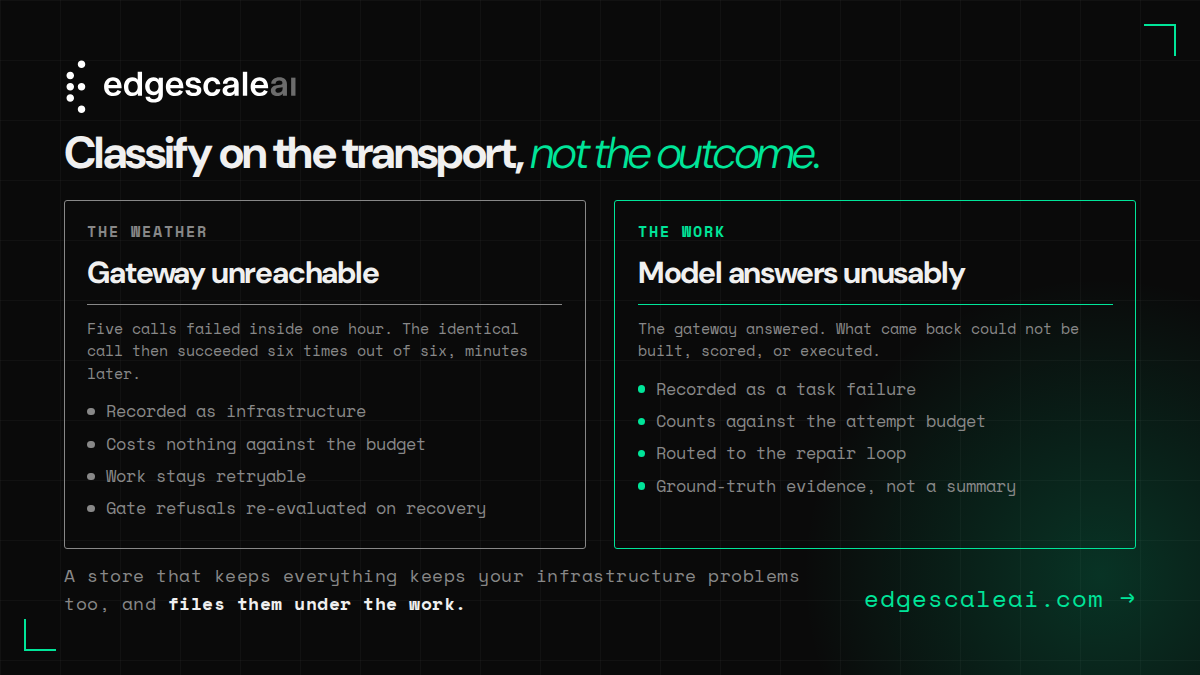
The gateway flaps. Measured inside a single hour: five generation calls failed with “Connection error”, and the identical call then succeeded six times out of six a few minutes later. Every station that talks to a model – the test author, the quality reviewer, the security reviewer, the admission gate, the repair loop, the prioritizer, the voice intake – lost that cycle’s work to a blip it could have waited out.
That part is merely wasteful. The real problem was what got written down. Retries were bound then, so that an idea the model genuinely could not build would stop costing calls forever – but a connection error counted against that budget exactly like a real failure did. Three gateway blips could permanently abandon an idea for a reason that had nothing to do with the idea. The same shape turned up at the admission gate: when the authority check could not reach the model, the gate did what a fail-closed gate is supposed to do and wrote a refusal. That refusal is an artifact. It is durable, and on its face it is indistinguishable from a considered no.
A store that keeps everything keeps your infrastructure problems too, and files them under the work. So the classification is now made on the transport rather than on the outcome. An unreachable gateway is recorded as infrastructure, costs nothing, and leaves the work retryable. A model that answers unusably has failed at the task, and that is what a budget is for. Refusals that exist only because the gateway errored are recognised as such and re-evaluated once it is back. The attempt ceiling itself came out entirely a while later, which only became a safe thing to do once an outage was free.
These are one failure wearing three coats. The store records what happened, and it records it exactly, and it has no opinion whatsoever about whether what happened was the work or the weather. Telling those two apart is not something you get for free by writing everything down. It is the part you have to build.
Why the record has to outlive the model
If you’re running a physical operation, here’s the takeaway that matters most for you.
In Part 2, I mentioned that we moved the remediation agent onto a different model, because the one it was running on truncated its own output on longer repair orders. That swap took an afternoon. Nothing else in the factory changed. Every artifact produced before the swap is still valid, still hash-chained, still auditable, and still exactly as useful as it was.
That is the whole argument – that models are components. They get better, they get deprecated, they get replaced, and the ones we are using now will not be the ones we are using in two years. If your accumulated operational knowledge lives inside a model, every one of those transitions is a loss event. If it lives in a store you own, sitting on hardware you own, in your own building, the model becomes a part you can swap without losing your operational memory.
Our CTO, Marc, describes the artifact foundation as accumulating the way DNA does, and as a kind of twin of the operation that is free of any proprietary model. The store is the only part of this system that gets more valuable every day it runs, and it is the only part that does not belong to a vendor.
For a factory, that is not an architectural preference. Twelve years of accumulated modifications, sensor drift and hard-won operational knowledge is their biggest asset. Any system that can only hold that knowledge inside somebody else’s weights is asking you to rent your own history back.
In Part 4, my colleague Praveen Mada takes over to explain the piece that all of this rests on: the model gateway that lets the factory treat inference as fleet infrastructure rather than a dependency on any single model. Stay tuned!