
Data Sovereignty, Contractual Evasion, and the Private Infrastructure Mandate
The Fortune 500’s adoption of AI has led to a crisis in data governance and risk management. As organizations move toward production-scale deployments, the traditional safeguards of Software-as-a-Service (SaaS) agreements are often insufficient to address the unique complexities of model training and inference. Legal counsel is increasingly encountering a landscape characterized by technical obfuscation and a systematic shift of liability from providers to deployers.
The Taxonomy of Technical Evasion
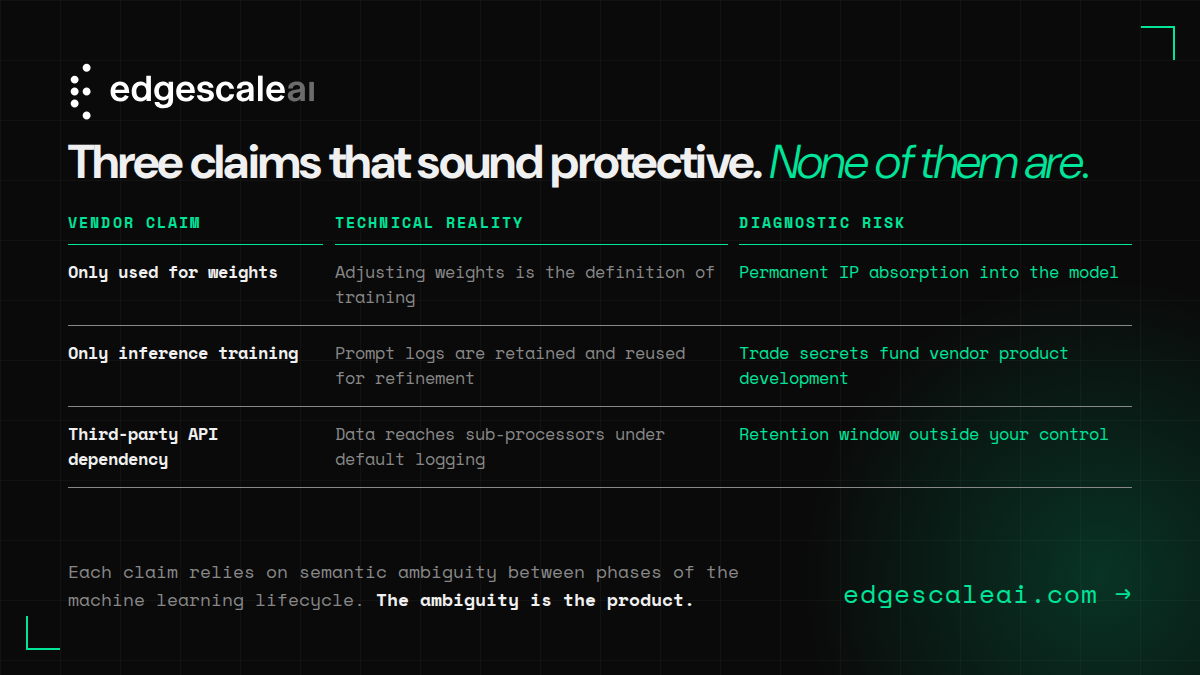
Legal counsel often encounter vendor claims that appear protective but hide significant data persistence risks. These claims frequently rely on semantic ambiguity between the phases of the machine learning lifecycle.
Deconstructing Vendor Claims
- “We only use your information for weights.” This is fundamentally evasive because the process of adjusting weights is the definition of training. If proprietary data is used to update weights via back-propagation, that data can become semantically encoded within the model, creating risks of data leakage and complicating future data deletion requests.1
- “This is only for inference training.” This marketing term is often used to justify the persistence of data generated during the live application phase for future model refinement or Reinforcement Learning from Human Feedback (RLHF).1 For an enterprise, this means sensitive queries – which may contain trade secrets – are reused for product development, often violating purpose-bound data processing principles.
- “We use third-party APIs and cannot guarantee privacy.” In many instances, vendors use third-party APIs – such as OpenAI’s – as a shield to justify an inability to guarantee data sovereignty. This evasiveness can mask a failure to properly configure Zero Data Retention (ZDR) or secure an appropriate Data Processing Addendum (DPA).4 Without these configurations, enterprise data is often subject to default 30-day retention logs for abuse monitoring.4
| Vendor Claim | Technical Reality | Diagnostic Risk |
| “Only for weights” | Data is encoded into model parameters. | Permanent IP absorption into the model. |
| “Inference training” | Prompt logs are reused for model refinement. | Unauthorized data reuse for vendor profit.1 |
| “API dependency” | Data is sent to third-party sub-processors. | 30-day retention lag for abuse monitoring.4 |
The Legal Counsel’s Sovereignty Vetting Toolkit
To navigate these evasive tactics, legal counsel should move beyond standard security audits and implement an AI-specific risk questionnaire.
Data Usage and Training Rights
- Weights and Parameters: Does the vendor use customer data to adjust any model weights, parameters, or internal configurations? If so, can the vendor provide a technical mechanism to “unlearn” or remove this data upon request?
- Secondary Usage: Does the vendor claim rights to use customer prompts or outputs to refine general-purpose models? Does the contract explicitly include “no training,” “no commingling,” and “no retention” provisions for the entire model lifecycle?
- Derivative Data: Who owns embeddings, metadata, and fine-tuning outputs generated during the engagement?
Technical Architecture and Sub-processing
- API Configuration: If the solution is a “wrapper” for a third-party API, has the vendor secured a Zero Data Retention (ZDR) status? Can they provide the specific project IDs or documentation proving that abuse monitoring logs have been disabled?4
- Human-in-the-Loop: Does the vendor’s policy for “Abuse Monitoring” allow for human review by authorized employees or third-party contractors?
- Isolation: Can the vendor provide a technical guarantee of “Model Isolation,” ensuring that the specific instance of the model used by the enterprise is siloed from other customers?
Governance and Accountability
- Auditability: Does the vendor maintain an immutable record of AI usage and decision-making for at least six months to support regulatory investigations?
- Drift and Bias: What are the vendor’s pass/fail thresholds for model drift and accuracy, and what are the contractual remedies if performance falls below these benchmarks?
- Termination Rights: Does the contract provide for “model unwinding” (the removal of customer influence from the model) or transition support to ensure data portability upon exit?
The Strategic Shift to Sovereign AI
Faced with the transparency gap of public cloud providers, many Fortune 500 companies are prioritizing Sovereign AI. This strategy focuses on maintaining absolute authority over the entire AI technology stack, including infrastructure, data, models, and operations.
The Pillars of Sovereignty
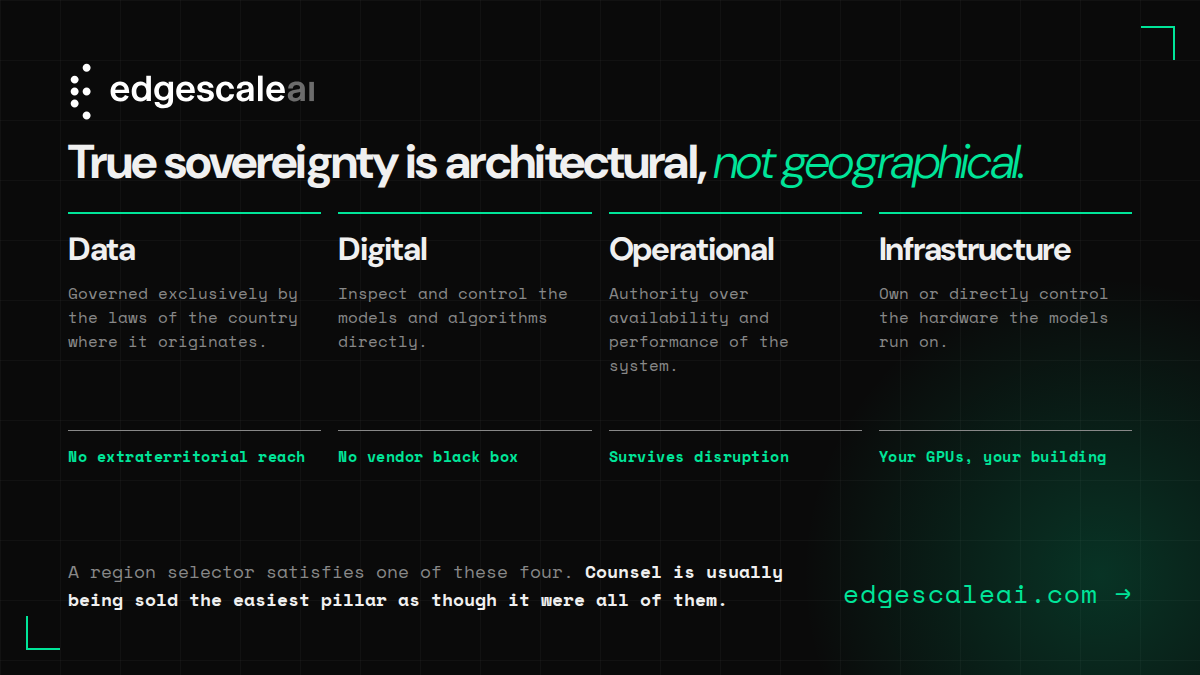
True sovereignty is architectural, not just geographical. It requires:
- Data Sovereignty: Ensuring data is governed exclusively by the laws of the country where it originates, avoiding extraterritorial reach.7
- Digital Sovereignty: The ability to inspect and control the models and algorithms directly, rather than relying on a vendor’s “black-box” implementation.7
- Operational Sovereignty: Maintaining authority over system availability and performance, ensuring the AI remains accessible even during geopolitical or network disruptions.7
- Infrastructure Sovereignty: Owning or directly controlling the hardware—such as GPUs and private clouds—on which the models run.
How Physical AI Infrastructure Closes the Gap
Physical AI Infrastructure solutions, like Edgescale’s Cube, replace the crisis of vendor evasion and API dependency with an on-site, autonomous alternative: a single plug-and-play appliance with an integrated AI hardware & software stack that resides entirely within an organization’s physical and logical boundaries, marking the shift from Cloud AI to Physical AI.
Running Sovereign AI inference locally on vLLM behind the facility’s physical firewall, the Cube eliminates the need for external API calls, bypassing the risks of misconfigured third-party logs or “inference training.” Its Data Manifold capability handles the local connection and aggregation of information from machines and sensors, so data never has to traverse the public internet. Sovereignty is baked in at the design level for mission-critical facilities, such as factories and labs, where privacy and real-time resilience are non-negotiable.
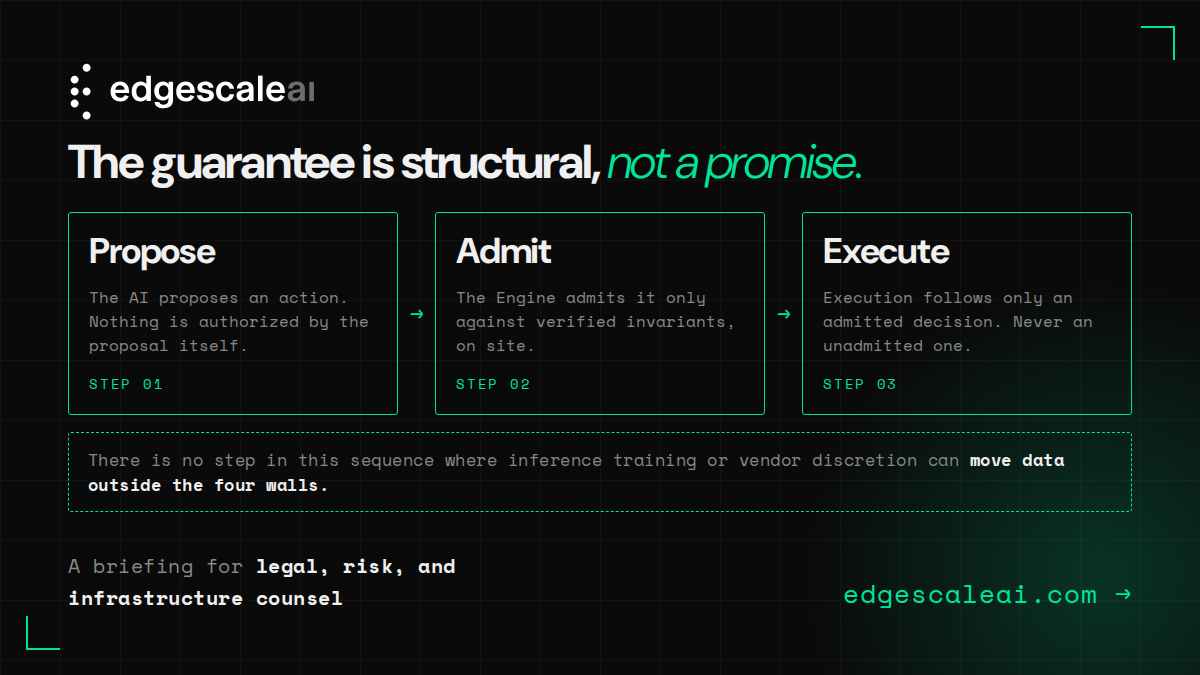
That guarantee isn’t a promise legal counsel has to take on faith. The Engine, Edgescale’s on-site governance layer, enforces it structurally through its Propose-Admit-Execute model: the AI proposes an action, The Engine admits it only against verified invariants, and execution follows only an admitted decision. There’s no step in that sequence where inference training or vendor discretion can move data outside the four walls.
Works cited
- AI Model Training vs Inference: Key Differences Explained – Clarifai, accessed April 17, 2026, https://www.clarifai.com/blog/training-vs-inference/
- The Rise of AI Vendor Agreements: 7 Clauses Every Business Needs to Get Right in 2025, accessed April 17, 2026, https://holonlaw.com/ai/the-rise-of-ai-vendor-agreements/
- AI Governance: Framework, Compliance & Operational Guide (2026) – Ethyca, accessed April 17, 2026, https://www.ethyca.com/news/ai-governance
- Enterprise privacy at OpenAI | OpenAI, accessed April 17, 2026, https://openai.com/enterprise-privacy/
- Navigating AI Vendor Contracts and the Future of Law: A Guide for Legal Tech Innovators, accessed April 17, 2026, https://law.stanford.edu/2025/03/21/navigating-ai-vendor-contracts-and-the-future-of-law-a-guide-for-legal-tech-innovators/
- Data controls in the OpenAI platform, accessed April 17, 2026, https://developers.openai.com/api/docs/guides/your-data
- What is AI Sovereignty? – IBM, accessed April 17, 2026, https://www.ibm.com/think/topics/ai-sovereignty
- What Is Data Sovereignty? Challenges & Best Practices, accessed April 17, 2026, https://www.snowflake.com/en/fundamentals/what-is-data-sovereignty/
- Sovereign AI: Guide and Best Practices | Mirantis, accessed April 17, 2026, https://www.mirantis.com/blog/sovereign-ai/